Consult




A fully equipped protection system — surge arresters, overcurrent protection, nothing missing — is that enough to guarantee safe reactor switching?
One 220 kV substation has given the answer: no.
Four sets of 35 kV shunt reactors broke down one after another within three years, even though the surge arresters meant to prevent overvoltage were online the whole time, and the equipment passed every test when returned to the factory.
1. First, the Failures
Shunt reactors absorb the excess reactive power on lightly loaded lines and pull the risen voltage back to normal. Their mode of operation is to be switched in and out repeatedly as the voltage changes.
The case described above involves four sets of 6,000 kvar dry-type shunt reactors with 35 kV vacuum circuit breakers, commissioned in 2015; by April 2018 all four had broken down within three years.
The failure pattern was strikingly consistent: every case occurred within seconds of energization, with the overcurrent stage-I protection tripping; teardown inspections all showed surface flashover from the winding ends to the core or clamping frames, with extensive contamination on the surface.
The equipment itself is not expensive. But four outages and multiple factory returns spanning three years consumed costly outage windows and maintenance resources.
2. From the Equipment to the Switching Operation
In the post-mortem, manufacturing quality was the first suspicion. One unit was sent back and put through the full set of type and routine tests again — and passed; reactors of the same model run well at other substations. That line of inquiry ended there.
Attention shifted to operating conditions. All four failures occurred within seconds of energization — if the insulation were weak at operating voltage, it would not wait specifically for the instant of energization to fail.
This timing characteristic rules out steady-state defects.
The most likely main cause is switching overvoltage: high-frequency impulses at closing or at the previous opening act repeatedly, progressively accumulating insulation damage; and the extensive surface contamination found on the windings makes flashover at the ends even easier — the two together produce the shared "seconds after energization" timing.
Field measurements of the switching process followed. Across 5 switching operations, phase C bounced on all 5 closings, and restruck on 4 of the 5 openings.
The causes fall into three parts:
① Current chopping — the strong arc-quenching capability of the vacuum breaker cuts a small current before it naturally reaches zero; the energy stored in the inductance transfers into the circuit's stray capacitance and excites high-frequency oscillation;
② Restrike on opening — the transient recovery voltage rises faster than the contact gap's dielectric strength recovers, or the gap is still too small at current zero, and the arc restrikes;
③ Closing bounce — after the moving and fixed contacts collide, the contact spring's reaction force throws them apart again; this is a mechanical characteristic, unrelated to the arc-quenching medium. Each bounce restrikes the gap once, adding one more high-frequency oscillation to the circuit.
The magnitude was measured too. The voltage at the instant of closing peaked at 211 kV, 6.4 times normal. The national standard treats anything within 4 times as a safe range, yet this reactor's impulse withstand voltage is only 185 kV.
The problems concentrated entirely in phase C; phases A and B both stayed below 1.4 times.
3. Three Conventional Remedies, Each with Its Price
In the post-mortem, every available countermeasure against switching overvoltage was reviewed one by one. They come down to three categories; all three work, but each carries a different price:
Add surge arresters — they can clamp the phase-to-ground and phase-to-phase overvoltage amplitude within the residual voltage. But switching overvoltage is a high-frequency oscillatory wave: arresters cannot suppress its steepness or frequency, nor protect the potential gradient between turns and at the winding ends; add the protection-distance effect and the operating threshold imposed by their mounting location, and the winding's line end can still take the harshest hit. The arresters were in place the whole time — and still did not stop this problem.
Add RC snubbers — an RC snubber treats the circuit. Adding capacitance and resistance changes the frequency and damping of the high-frequency oscillation, and the mechanism holds. The problem is its relatively high failure rate, which is why it is rarely used in the field today.
Switch to SF6 breakers — an SF6 breaker treats the source. Change the arc-quenching medium, and the chopping level is low and restrike is unlikely. But its enclosure is larger, which existing switchgear rooms often cannot accommodate; gas cylinders, recovery units, leak detectors and periodic top-ups form a maintenance system that must be sustained for years; and the gas must be recovered at retirement, while its global-warming potential is more than 20,000 times that of CO2.
So is there a better option?
4. The Fourth Path: Golead Intelligent's Phase-Controlled Breaker
Yes, there is: use Golead Intelligent's phase-controlled breaker and change the moment at which the switch operates.
Golead Intelligent began developing medium-voltage intelligent phase-controlled breakers back in 2011, aiming through per-phase, phase-selective control to suppress the transients generated when switching non-linear loads in the medium-voltage domain, protecting both the system and the load.
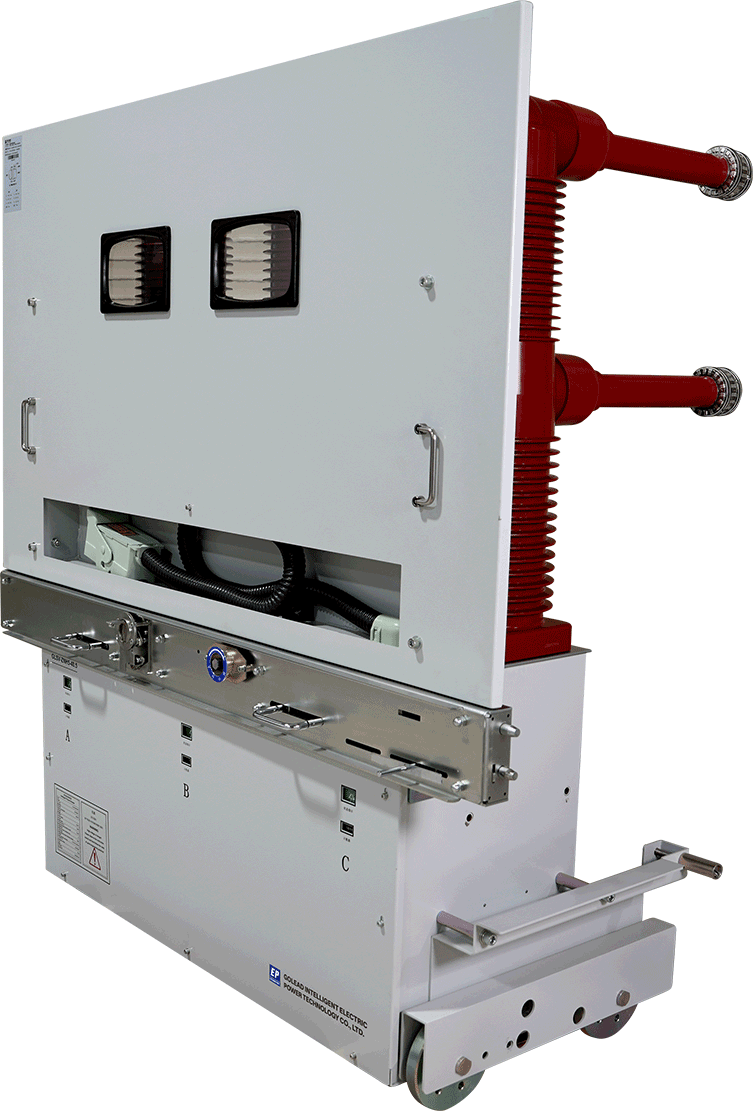
Using per-phase, phase-controlled technology, closing avoids the instant of voltage zero-crossing and lands near the voltage peak instead, minimising the closing transient; opening waits for the current to reach its natural zero, with the contacts already separated by a sufficient gap before that point, so the arc extinguishes on its own and does not restrike.
In July 2017, on the 35 kV side of a 220 kV substation in East China, a comparative test was run with Golead Intelligent's phase-controlled breaker. The station is fed by small hydropower and switches reactors frequently; one reactor set had long shown pronounced switching overvoltage during interruption.
The same breaker was tested under two operating conditions:
Phase control ON (10 switching operations): closing inrush peaked at 1.14 times, opening overvoltage peaked at 3.16 times, and the arresters did not operate once. Phase control OFF (1 switching operation): closing inrush peaked at 2.12 times, opening overvoltage peaked at 5.08 times, and the arresters operated on phases B and C. |
The above data are taken from the field test report issued by a third-party inspection body.
Between the two conditions there was only one variable: the moment the switch operated.
Field measurements show that, under the conditions of this test, switching phase control on and off made inrush current and opening overvoltage drop markedly, and the arresters no longer operated.
Golead Intelligent's phase-controlled breaker takes control of the two variables that matter most — the worst-case closing angle and the arcing time on opening — thereby suppressing closing inrush and the overvoltage caused by repeated restrikes; and restrikes, together with the equivalent chopping they induce in the non-first-clearing phases, are precisely the main source of this type of failure.
The core advantages of the fourth path:
No change to primary equipment. The reactors stay, the main connection stays, the existing cable feeders are reused; the work is usually finished within a single planned outage window.
Results you don't have to extrapolate. Same breaker, same site, phase control on and off — the before-and-after difference is visible and measurable, right there in the data.
Replicable at existing stations. No expansion, no new land. Stations with similar space conditions can be retrofitted in essentially the same way.
Having read this far, you might want to check one thing: has the switching overvoltage of your shunt reactors' switching device ever been measured?
If you have questions about switching reactors or other non-linear loads, feel free to consult us at any time.