Consult




The production line stopped.
Yet the power supply system was perfectly normal — no fault records, no protection operations, and a search across the whole plant turned up no incident at all.
The only anomaly was a voltage dip tens of milliseconds earlier.
No outage, no tripping — the alarm lamp might not even have lit.
Yet in that very instant, the variable-frequency drives blocked, the contactors dropped out, and the control circuits lost power.
Then came the shutdown, the scrapping of work-in-progress, and production capacity falling to zero.
The cost of a single voltage sag can reach hundreds of thousands — even millions — of yuan.
In post-incident reviews, one remark is heard again and again across the industry:
“Our automatic bus-transfer device operated — and it operated correctly. It is just that by the time it finished operating, all the loads had already stopped.”
The issue is not whether you have installed a bus-transfer device. It is that conventional solutions, from the very first day of their design, were never built to “keep the loads alive.”
1. Voltage Sag: Stopping the Line Without Ever Cutting Power
A momentary voltage dip — known in the industry as a “voltage sag.”
It is nowhere near as conspicuous as an outage, yet it is the number one cause of unplanned downtime in manufacturing.
The head of the Market Regulation Department of the National Energy Administration gave a direct assessment of voltage sags:
“Last year, power-quality problems such as voltage sags emerged in Shanghai, Hainan and elsewhere, affecting the production and operation of enterprises.”
As for the cost — in industries such as semiconductors, precision manufacturing and medical equipment, the average loss from a single voltage sag can reach hundreds of thousands of yuan (according to public reports by central media outlets).
For any particular enterprise, that figure depends on the value of the production line and how long it stays down.
Take a large chemical complex in Jiangsu we have served: total investment over USD 5.5 billion, annual capacity around 3 million tonnes. When a line like that goes down once, the bill cannot be settled with a few hundred thousand yuan.
It cuts no power, yet it stops the line. That is the most troublesome thing about a voltage sag.
And the truly expensive equipment on site has a tolerance window that is startlingly narrow.
Equipment | Sensitivity threshold | Consequence |
Variable-frequency drive (ASD) | Undervoltage protection is typically set at 70%–80%; typical ride-through time 15–20 ms | Motor stops, process interrupted |
AC contactor | Per GB/T 14048.4 it must release once control voltage drops below 75% — the most sensitive models drop out right at 75%; release time 10–20 ms | Motor group trips, cascading shutdown |
PLC / industrial PC | Some models stop working when voltage < 80% (semiconductor equipment must ride through 50% / 0.2 s per SEMI F47) | Program reset, data loss |
Robot / precision machining | Trips at voltage < 90% lasting 40–60 ms (typical value) | Workpiece scrapped, precision lost |
The hardest problem in voltage-sag mitigation is this: in the worst kind of sag, the operating window that sensitive loads leave you can be as short as 15–20 milliseconds.
Voltage sags come from two directions.
One is the external grid — lightning strikes, short circuits, third-party damage, faults at neighbouring customers. You cannot dodge these; you can only ride them out.
The other is self-inflicted inside the plant — starting of large motors, transformer closing inrush, capacitor bank switching, electric-arc-furnace impact. At process-industry sites this part weighs even heavier.
The conclusion is harsh: in all likelihood a voltage sag cannot be prevented — it can only be “ridden out.” And whether you ride it out depends entirely on how fast your solution is.
2. Why Conventional Solutions Cannot Save the Line: Four Blind Spots
There are four conventional approaches to dealing with voltage sags at industrial sites.
Let us take them apart one by one and see exactly where each one gets stuck.
Blind Spot 1: Conventional Bus Transfer (BZT) — It Waits for “Voltage Loss,” and the Moment It Moves, Loads Are Lost
The logic of a conventional bus-transfer (BZT) scheme is: detect busbar voltage loss → trip the working supply → close the standby supply.
It is initiated by “no busbar voltage,” so it must wait until the residual voltage decays to the set value before it acts — and by the time it starts, the loads are long gone.
What is more, “break before make” means there is inevitably a period of plant-wide loss of supply in between. By design it accepts that “this time the loads will be lost.” What it guards against is “a prolonged outage,” not “a sag.”
Overall operating time: on the order of seconds.
Blind Spot 2: Conventional Fast Transfer Device + Conventional Breaker — The Brain Got Faster, the Limbs Did Not
A fast transfer device is a big step forward from bus transfer: it tracks residual voltage, frequency deviation and phase-angle difference, and closes at the optimal moment, so the switching inrush is far smaller and the speed far higher.
But it runs into a physical ceiling it cannot get around — the actuator is a conventional vacuum circuit breaker. However fast the device’s “brain” is, the command still has to be carried out by a breaker whose opening and closing are measured in tens of milliseconds. Every millisecond saved in the decision stage is eaten up again in the execution stage.
Part of the load is saved, but the most sensitive part is still lost.
Total transfer time: on the order of 100 ms.
Blind Spot 3: UPS / DVR — Can Ride Out a Second, but Not a Real Loss of Supply
The idea behind a UPS and a Dynamic Voltage Restorer (DVR) is to “hold the line locally”: a UPS transfers in zero time and a DVR responds in 1–2 ms, so response speed really is fast.
But they are good at “riding out a dip,” not at “switching to another route.” If the fault is a sustained, genuine loss of supply, everything still has to stop after 1–2 seconds.
And since investment is priced per kVA while stored energy is measured in seconds — with DVR cost being extremely high on top of that — they can usually cover only control circuits and a handful of critical loads, never the motor group of an entire production line.
Blind Spot 4: Anti-Sag Contactors / Staged Restart — An End-of-Line Patch That Treats the Symptom, Not the Cause
Fitting contactors with delayed-release modules and restarting motors in batches is the lowest-cost approach,
but it safeguards only one single point — the contactor coil. Drives and PLCs still trip. Holding time is limited, so it fails completely when the sag is deep or long. And at the instant power returns, many motors start simultaneously; their inrush currents superimpose and can drag down the very system that has just recovered.
Solutions of this kind deal with “the symptom at the equipment end,” not “the root cause on the supply side.”
All four blind spots point to one and the same core contradiction.
Solution | Core approach | Key speed | Blocking point (hard constraint) | Coverage |
Conventional bus transfer (BZT) | Waits for “voltage loss”: detect busbar voltage loss → trip working supply → close standby supply | Initiation criterion several hundred ms; overall on the order of seconds | The criterion — residual voltage must decay to 20%–30% Un before it starts, while sensitive loads have already dropped out at 18–20 ms; it does not track residual-voltage phase, so closing inrush can reach 4–7 times rated current; break-before-make always leaves a plant-wide outage window | Whole-plant busbar, but designed to accept that loads will be lost |
Conventional fast transfer device + conventional breaker | Tracks residual voltage, frequency deviation and phase-angle difference; closes at the optimal moment | Decision in milliseconds; transfer time about 100 ms | The actuator — a vacuum breaker opens in 40–60 ms and closes in 60–80 ms; the time saved at the decision stage is entirely consumed at the execution stage | Busbar level; the most sensitive loads are still lost |
UPS / DVR | Holds the line locally; does not switch to another route | UPS 0 ms (fully isolates the disturbance); DVR 1–2 ms | Energy — a UPS loses 4%–8% in efficiency and its batteries need replacing every 3–5 years and are temperature-sensitive; a DVR stores only 1–2 s and, being connected in series, represents a single point of failure; investment in either is priced per kVA | Control circuits plus a few critical loads |
Anti-sag contactor / staged restart | Prevents dropout at the end device + restarts motors in batches once power returns | Contactor holds for 1–3 s | Scope — it protects only the contactor coil; it cannot protect drives (15–20 ms undervoltage blocking) or PLCs (which stop below 80%); simultaneous restart of multiple motors superimposes their inrush currents | Individual device level |
Comparison of the four conventional routes: different sticking points, the same root cause
3. Guolizhineng’s Answer: From a “Fast Transfer Device” to a “Fast Transfer System”
To cover every voltage-sag scenario, a single device is not enough. Our solution has two progressive tiers: the device is responsible for “thinking fast,” and the system for “acting fast.”
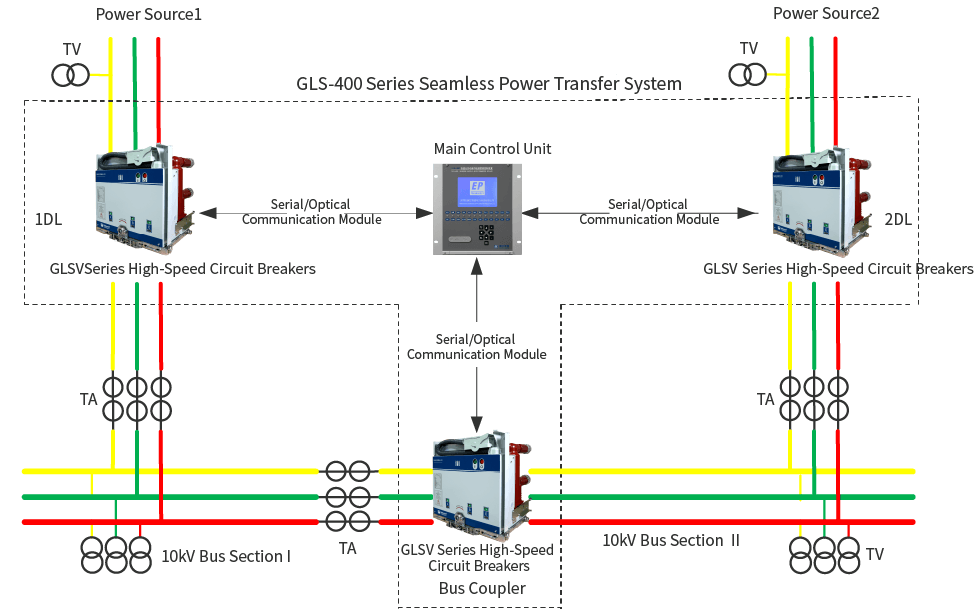
When the working supply fails or a voltage sag occurs, an external-grid fault can be identified within 2–5 ms, the faulty source disconnected and a healthy source switched in.
The entire supply transfer time (decision and control + breaker execution) can be completed within one power-frequency cycle at the fastest, ensuring continuous operation of (sensitive) loads.
Parameter | Value | What it means |
Opening time | ≤ 5 ms | About 10 times faster than a conventional circuit breaker |
Closing time | ≤ 10 ms | Driven by a permanent-magnet repulsion dual mechanism |
Operating-time dispersion | ≤ ±0.5 ms | Not an average value — the worst case under all conditions |
Mechanical endurance | ≥ 30,000 operations (class M2; electrical endurance E2) | Frequent operation is nothing to fear |
Operating power demand | External supply current < 0.5 A | No additional power-supply modification needed |
4. In Closing
What makes a voltage sag so troublesome is precisely that it is not a total loss of power — so adding more supply feeders does not solve it. On top of that, conventional protection does not take it seriously, and during the post-mortem you cannot even say exactly what happened in those tens of milliseconds; all you know is that the line stopped.
For more than forty years, Guolizhineng has been dedicated to the field of safe power-supply transfer control.
When a fault strikes, every millisecond saved is another production line kept running.
END